>6 month superior
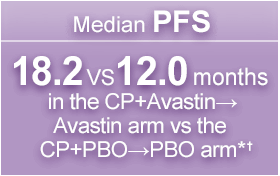
median PFS1
 in stage III or IV
ovarian cancer
VS chemotherapy alone after
primary surgery
in stage III or IV
ovarian cancer
VS chemotherapy alone after
primary surgery
in stage III or IV
ovarian cancer
VS chemotherapy alone after
primary surgery
Boxed WARNINGS
- Gastrointestinal (GI) perforation
- Surgery and wound healing complications
- Hemorrhage


VIEW DATA
Scroll for important safety information, including Boxed WARNINGS.
Indication
Avastin, in combination with carboplatin and paclitaxel, followed by Avastin as a single agent, is indicated for the treatment of patients with stage III or IV epithelial ovarian, fallopian tube, or primary peritoneal cancer following initial surgical resection.
Boxed WARNINGS
- Gastrointestinal (GI) perforation
- Serious and sometimes fatal GI perforation occurs at a higher incidence in Avastin-treated patients compared to patients treated with chemotherapy
- The incidence of GI perforation ranged from 0.3% to 3% across clinical studies
- Discontinue Avastin in patients with GI perforation
- Surgery and wound healing complications
- The incidence of wound healing and surgical complications, including serious and fatal complications, is increased in Avastin-treated patients
- Withhold Avastin for at least 28 days prior to elective surgery. Do not administer Avastin for at least 28 days after surgery and until the wound is fully healed
- Discontinue in patients with wound healing complications requiring medical intervention
- Hemorrhage
- Severe or fatal hemorrhage, including hemoptysis, GI bleeding, hematemesis, central nervous system hemorrhage, epistaxis, and vaginal bleeding, occurred up to 5-fold more frequently in patients receiving Avastin. In clinical studies, the incidence of grade ≥3 hemorrhagic events among patients receiving Avastin ranged from 0.4% to 7%
- Do not administer Avastin to patients with serious hemorrhage or a recent history of hemoptysis (≥1/2 tsp of red blood)
- Discontinue Avastin in patients who develop grade 3-4 hemorrhage
Additional serious adverse events
- Additional serious and sometimes fatal adverse events with increased incidence in the Avastin-treated arm vs chemotherapy arm included:
- Non-GI fistulae (<1% to 1.8%, highest in patients with cervical cancer)
- Arterial thromboembolic events (grade ≥3, 5%, highest in patients with GBM)
- Renal injury and proteinuria
- Grade 3–4 proteinuria ranged from 0.7% to 7% in clinical studies
- Nephrotic syndrome (<1%)
- Additional serious adverse events with increased incidence in the Avastin-treated arm vs chemotherapy arm included:
- Venous thromboembolism (grade ≥3, 11% seen in GOG-0240)
- Hypertension (grade 3–4, 5%–18%)
- Posterior reversible encephalopathy syndrome (PRES) (<0.5%)
- Congestive heart failure (CHF): grade ≥3 left ventricular dysfunction (1%)
- Infusion reactions with the first dose of Avastin occurred in <3% of patients, and severe reactions occurred in 0.2% of patients
- Avoid use in patients with ovarian cancer who have evidence of recto-sigmoid involvement by pelvic examination or bowel involvement on CT scan or clinical symptoms of bowel obstruction
- Inform females of reproductive potential of the risk of ovarian failure prior to initiating treatment with Avastin
Pregnancy warning
- Based on the mechanism of action and animal studies, Avastin may cause fetal harm
- Advise female patients that Avastin may cause fetal harm, and to inform their healthcare provider of a known or suspected pregnancy
- Advise females of reproductive potential to use effective contraception during treatment with Avastin and for 6 months after the last dose of Avastin
- Advise nursing women not to breastfeed during treatment with Avastin and for 6 months following their last dose of treatment
- Avastin may impair fertility
Most common adverse events
- Across studies, the most common adverse reactions observed in Avastin patients at a rate >10% were:
- Epistaxis
- Headache
- Hypertension
- Rhinitis
- Proteinuria
- Taste alteration
- Dry skin
- Rectal hemorrhage
- Lacrimation disorder
- Back pain
- Exfoliative dermatitis
- Across all studies, Avastin was discontinued in 8% to 22% of patients because of adverse reactions
Indication-specific adverse events
- In Stage III or IV OC after primary surgery, 608 patients received CP+Avastin→Avastin, 607 patients received CP+Avastin→PBO, and 602 patients received CP+PBO→PBO. Grade 3–4 adverse reactions occurring at a higher incidence (≥2%) in either of the Avastin arms vs the chemotherapy only arm were fatigue (CP+Avastin→Avastin, 9%; CP+Avastin→PBO, 6%; CP+PBO→PBO, 6%), hypertension (CP+Avastin→Avastin, 10%; CP+Avastin→PBO, 6%; CP+PBO→PBO, 2%), platelet count decreased (CP+Avastin→Avastin, 21%; CP+Avastin→PBO, 20%; CP+PBO→PBO, 15%), and white blood cell count decreased (CP+Avastin→Avastin, 51%; CP+Avastin→PBO, 53%; CP+PBO→PBO, 50%)
You may report side effects to the FDA at (800) FDA-1088 or www.fda.gov/medwatch.
You may also report side effects to Genentech at (888) 835-2555.
Please see full Prescribing Information, including Boxed WARNINGS, for additional important safety information.
PFS=progression-free survival; CP=carboplatin + paclitaxel; PBO=placebo; HR=hazard ratio; CI=confidence interval.
*HR=0.62 (95% CI, 0.52–0.75), P<0.0001.
†GOG-0218 was a Phase III, multicenter, randomized, double-blind, placebo-controlled trial.1,2
*HR=0.62 (95% CI, 0.52–0.75), P<0.0001.
†GOG-0218 was a Phase III, multicenter, randomized, double-blind, placebo-controlled trial.1,2
References: 1. Avastin Prescribing Information. Genentech, Inc. 2018.
2. Burger RA, Brady MF, Bookman MA, et al. N Engl J Med. 2011;365:2473-2483.
2. Burger RA, Brady MF, Bookman MA, et al. N Engl J Med. 2011;365:2473-2483.
©2018 Genentech USA, Inc. All rights reserved.
(12/18) AVP/110718/0035

Please see full Prescribing Information, including Boxed WARNINGS, for additional important safety information.